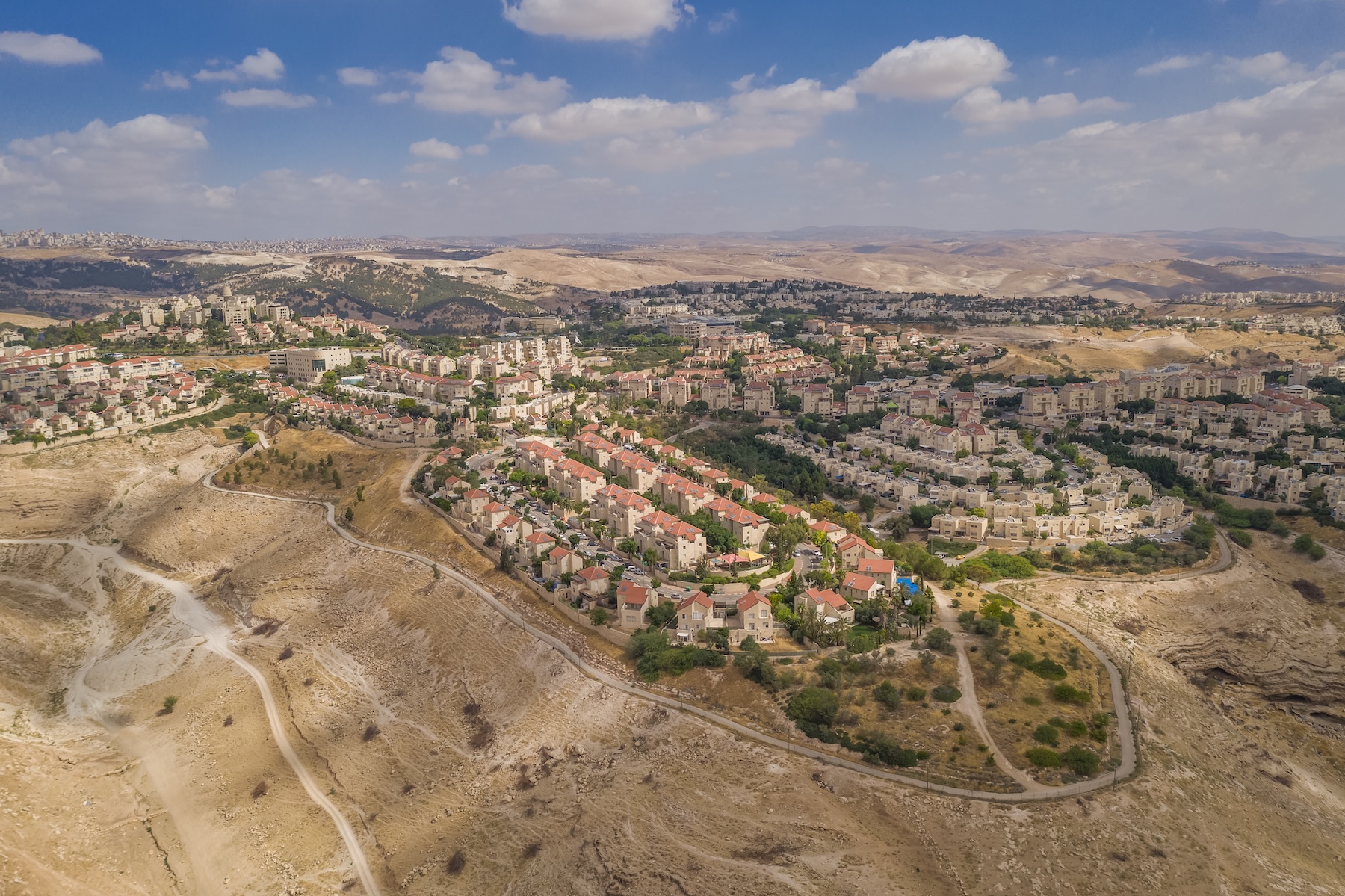
More and more Western states are rallying to impose sanctions or bans on trade in products from “illegal Israeli settlements”. In almost all cases, these countries argue that these restrictions are justified by international law. In some cases, specific reference is made to the 2024 Advisory Opinion of the International Court of Justice (ICJ).
In this article we review the main developments, discuss the recent court case in The Netherlands, and dive deeper into the significance of the ICJ Advisory Opinion. Specifically, we will examine whether the 2024 Advisory Opinion or international law requires or justifies the imposition of trade restrictions.
In short, this article argues that neither international law nor the ICJ requires or justifies the imposition by states of a blanket trade restriction on trade in products emanating (in whole or in part) from certain geographical locations in the territories administered by Israel since the June 1967 war.
The trade bans now being imposed or envisaged seem to be primarily based on the argument that they will incentivize Israel to dismantle the “Israeli settlements”, which (they argue) prevent the fulfilment of the “two states solution”. However, even if it is accepted that (a) Palestinian statehood is a desirable policy objective, and (b) the mere presence of Israeli citizens in these territories is impeding the establishment of Palestinian state (both of these assumptions are highly questionable), the states imposing these bans have not provided objective, empirical evidence that trade restrictions will in any way influence Israel’s allegedly illegal conduct or advance the achievement of a Palestinian state. They thus appear to have more of a punitive than regulatory character.
Trade bans – recent developments
On September 8, twelve countries — the UK, France, Canada, Denmark, Finland, Iceland, Ireland, Norway, Poland, Portugal, Spain and Sweden —issued a statement jointly pledging to “introduce national and/or support European restrictions on trade in goods with settlements which are illegal under international law.”
Britain, France and Canada are the ones actually pulling the trigger: UK Foreign Secretary Ed Miliband announced a full import ban on settlement goods within nine months, paired with “action against specific companies and individuals” financing or building in the settlements, though he carved out exemptions for religious items and Israeli medicines. The other nine committed only to “support further action” — a hedge that leaves plenty of room for the coalition to fray before Britain’s own ban actually bites.
The twelve-nation statement frames the restrictions as compliance with international law rather than punishment. It cites: settlements being “illegal under international law” (naming the E1 project specifically); actions “tantamount to the annexation of Palestinian land”; the “forcible displacement of the Palestinian population”; “unprecedented levels of settler violence and settlement expansion”; a need to “ensure accountability for settler violence, and investigate allegations against Israeli forces”; and alignment with “relevant UN Security Council resolutions” supporting a two-state solution with Palestinian statehood alongside Israeli security.
This builds on ground already shifting under Israel’s feet for a year. Spain banned settlement imports first, in September 2025, followed by Slovenia, Belgium, and now the Netherlands, which adopted a national ban that takes effect September 22, 2026, covering goods from the West Bank and Golan Heights, including intermediate trade by Dutch companies abroad.
Ireland’s Occupied Territories Bill — applicable to goods only, after the government stripped out services over its own legal analysts’ objections — cleared its final vote in July and awaits signature.
It did not take Jerusalem long to answer. In response to the Dutch measures, in late August 2026, Foreign Minister Gideon Sa’ar ordered the expulsion of Dutch representatives from the International Support Center for Gaza (ISCG) in Kiryat Gat, giving them a week to leave — a measure approved by Prime Minister Netanyahu. Sa’ar framed it as retaliation for the Dutch trade ban, saying “those who act against Israel will have no foothold in the region,” and also tied it to what he described as rising antisemitism in the Netherlands coinciding with Dutch policy toward Israel. It echoed a similar move Israel had earlier made against Spain over its own settlement-goods restrictions. By late August, diplomatic sources indicated Israel was weighing further measures beyond the Kiryat Gat expulsion, though nothing specific had been announced. The Netherlands didn’t back down. Dutch Foreign Minister Tom Berendsen called the expulsion unnecessary, linked it to the upcoming Israeli elections, and said it “will not affect the decision of the Netherlands to ban products from illegal settlements.” The Dutch ban took effect as planned on 22 September, making the Netherlands the second EU country (after Spain) to impose such a measure
In response to the UK announcement, Israel closed the British consulate in East Jerusalem, pulled the UK out of the Gaza ceasefire support arrangements it had helped stand up, halted Palestinian Authority security training, and barred a dozen British parliamentarians from entry. Foreign Minister Gideon Sa’ar accused London and its partners of “stoking antisemitism”; on the British side, Reform MP Richard Tice called the sanctions a “grave mistake” that would embolden the very antisemitism Sa’ar warned of — a rare instance of an Israeli minister and a British opposition figure making the identical argument from opposite sides of the debate.
Dutch Court dismisses objection to import ban on Israeli settlement products
As of 22 September, a prohibition will come into force in the Netherlands on trade in products from Israeli settlements in the West Bank, East Jerusalem, and the Golan Heights. Dutch companies that act as intermediaries in such goods from abroad are also covered. The cabinet adopted this “General Administrative Order” (Algemene Maatregel van Bestuur, AMvB) in June. Because it is an administrative measure — and not a law — Parliament is in effect sidelined.
The Israel Products Center (IPC) and the European Jewish Association (EJA) tried to block the ban through summary proceedings. On 16 September the court ruled: both organizations lost on every point. IPC’s claims were dismissed, and EJA was even declared inadmissible — meaning the court did not even address the substance of its objections. Notable was the court’s own restrained stance: in an expedited procedure, it did not dare interfere with the minister’s policy discretion.
IPC put forward a number of arguments. Perhaps the most important was that only the European Union has the authority to impose this kind of trade restriction. However, EU law allows member states to unilaterally impose import restrictions on grounds of “public order.” The Dutch court accepted the State’s position that Israel’s conduct in the “unlawfully occupied territories” — including Israel’s decision to permit new settlements in the so-called E1 area, and steps taken toward annexation of (parts of) the West Bank — constitutes “a serious threat to the international legal order and thereby also a serious threat to a fundamental societal interest [in the Netherlands] that can justify an appeal to public order.”
But this reasoning does not hold up. Even if protection of the international legal order were a fundamental societal interest in the Netherlands, there is no evidence that imposing a boycott on trade in goods will in any way cause Israel to change its conduct in these territories, or in any other way improve the “protection of the international legal order”. In other words, that interest is not in fact more seriously threatened if the Netherlands does not impose a boycott.
Another controversial point in the ruling lies in the application of the Sanctions Act (Sanctiewet). That law permits the Netherlands to impose sanctions in order to comply with “recommendations of international organizations” — but only where those rules actually implement what is being recommended. The ICJ Advisory Opinion and the UN resolutions cited do not call on states to criminalize private economic activities between persons or entities located in the Netherlands and producers or suppliers of (component parts) of goods located in the occupied territories. In fact, the wording of the ICJ on this issue is much more nuanced and limited in scope, as we will see.
In the case of the Netherlands, the Dutch cabinet itself chose, on its own initiative, this specific measure — which it even itself describes as a means of moving Israel toward different policy “through pressure and dialogue,” not as the direct implementation of an international recommendation.
This is not the last word. IPC has since decided to appeal, and a more extensive full merits procedure also remains an option. The legal battle in The Netherlands over the settlements ban, then, is not yet over.
Status and content of the 2024 ICJ Advisory Opinion
Advisory opinions issued by the International Court of Justice occupy a different legal category from the Court’s judgments in contentious cases. Unlike the latter, they are not binding — a distinction the Court itself has repeatedly affirmed, and one reflected in the name: an advisory opinion is, formally, only an opinion. Yet in recent years that distinction has become increasingly blurred, as advisory proceedings have been used by parties to secure a judicial pronouncement on their legal claims without the consent normally required in contentious litigation. The July 2024 Opinion on the Occupied Palestinian Territory is widely seen as a case in point: the Palestinian side used the advisory route to obtain a judicial determination of its position vis-à-vis Israel, sidestepping the negotiation-based dispute-resolution mechanism to which both parties had actually agreed under the Oslo Accords.
Because advisory opinions do not bind even the states most directly connected to the dispute, they bind third states still less — including where the underlying obligations are said to be erga omnes. Non-compliance by a third state therefore does not give rise to state responsibility under Article 41 of the Articles on the Responsibility of States for Internationally Wrongful Acts. Some pro-Palestinian legal advocacy has sought to blur this by conflating erga omnes obligations with jus cogens norms, treating the Opinion as though it compelled third states — and companies within their jurisdiction — to sever ties with Israel. As ICJ Judge Dire Tladi cautioned in his own declaration on the Opinion, however, “the erga omnescharacter of the obligations does not itself create obligations on third States.”
Given the non-binding character of advisory opinions generally, and the procedural one-sidedness of this particular proceeding, states should treat the Opinion as advisory only — not as a basis for measures prejudging issues that UNSC Resolution 242 (1967) and the binding, negotiated Oslo Accords committed Israel and the Palestinians to resolve between themselves – including borders, security, settlements and Jerusalem.
Does the 2024 Advisory Opinion require or justify the imposition of trade restrictions?
In its Advisory Opinion, the Court concludes that:
- Israel’s prolonged occupation, settlement and annexation of the Palestinian territory occupied since 1967, including measures aimed at altering the demographic composition, character and status of them Holy City of Jerusalem, and from its adoption of related discriminatory legislation and measures are in breach of international law and that the maintenance of these policies and practices is an unlawful act of a continuing character entailing Israel’s international responsibility; and
- the continued presence of Israel in the Occupied Palestinian Territory is illegal.
This illegality has consequences for other states, because Israel owes these obligations to all other UN member states (erga omnes). The Court considers that other states have the following obligations:
- to abstain from entering into economic or trade dealings with Israel concerning the Occupied Palestinian Territory or parts thereof which may entrench its unlawful presence in the territory;
- to abstain, in the establishment and maintenance of diplomatic missions in Israel, from any recognition of its illegal presence in the Occupied Palestinian Territory; and
- to take steps to prevent trade or investment relations that assist in the maintenance of the illegal situation created by Israel in the Occupied Palestinian Territory
- not to recognize as legal the situation arising from the unlawful presence of the State of Israel in the Occupied Palestinian Territory;
- not to render aid or assistance in maintaining the situation created by the continued presence of the State of Israel in the Occupied Palestinian Territory
First, it should be noted that the Court’s reasoning concerning the illegality of Israel’s policies is highly debatable. For example, even if we accept that the territories are occupied within the meaning of international humanitarian law, “settlements” are only illegal to the extent that they involve the transfer or deportation by Israel of Israeli civilians into those territories. Israeli citizens in Area C who have move there voluntarily, and/or hold property ownership (in some cases going way back before 1948) can hardly be said to have been “deported or transferred”.
But even if the Court’s reasoning is accepted concerning Israel’s activities, nowhere does the Court prescribe the imposition of a blanket ban on trade, purchase, or sale of products made in the occupied territories (let alone criminalizing such activities).
At the very least, a state imposing such a restriction would need to show that the trade or investment that is being restricted “assists in the maintenance of the illegal situation created by Israel in the Occupied Palestinian Territory”. At the very least, there has to be a nexus between the trade activity and Israeli practices and policies. Arguably, not all private trade with or investment in entities located within what are euphemistically called “settlements” contributes to Israel’s illegal policies and practices.
For example, on what basis can it be alleged that the production of wine in Judea by an Israeli-registered company employing Palestinian workers is assisting the State of Israel to maintain its policies of (directly or indirectly) transferring Israeli citizens into those territories? What if that company’s business is conducted on land owned by the company (or its Jewish/Israeli owners) for over 100 years?
Conclusion
Israel’s relationship with the territories occupied by Egypt (Gaza Strip) and Jordan (East Jerusalem and the West Bank) between 1948 and 1967 is complex and multi-faceted. Israelis living and working in these territories are of all kinds of shapes and colors.
Because of the one-sided nature of the questions posed to it, these factual and historical complexities and nuances were almost totally ignored by the ICJ in its 2024 Advisory Opinion.
For the same reason, the Court adopted a superficial and imbalanced analysis of the legal questions. For example, the blanket use of the term “occupation” avoids a rigorous analysis of both the sovereignty of these territories prior to 1967 (such analysis being a pre-condition for determining the questions of occupation and statehood) and the contours and boundaries of the law of belligerent occupation. In a similar way, the term “settlement” does justice neither to the complex realities on the ground, nor to the nuances of international law.
Unfortunately, many governments use international law terminology as a cover for implementing their policies concerning the future of the Israeli Palestinian conflict, without carrying out an open, transparent and rigorous analysis of the international law questions involved. Instead, they insist that non-binding UN resolutions and ICJ opinions must be treated as binding law.
Unfortunately, as we have seen in several national court cases including the recent Dutch case, national courts are by and large reluctant to engage in a meaningful way with the arguments presented by those who challenge governments’ reliance on the superficial and one-sided approach of the UN and ICJ.
This twisting and manipulation of law and legal systems for political ends must be vigorously challenged. If that does not happen, we will rapidly descend into totalitarianism.