By Robbert van de Bovenkamp
Introduction
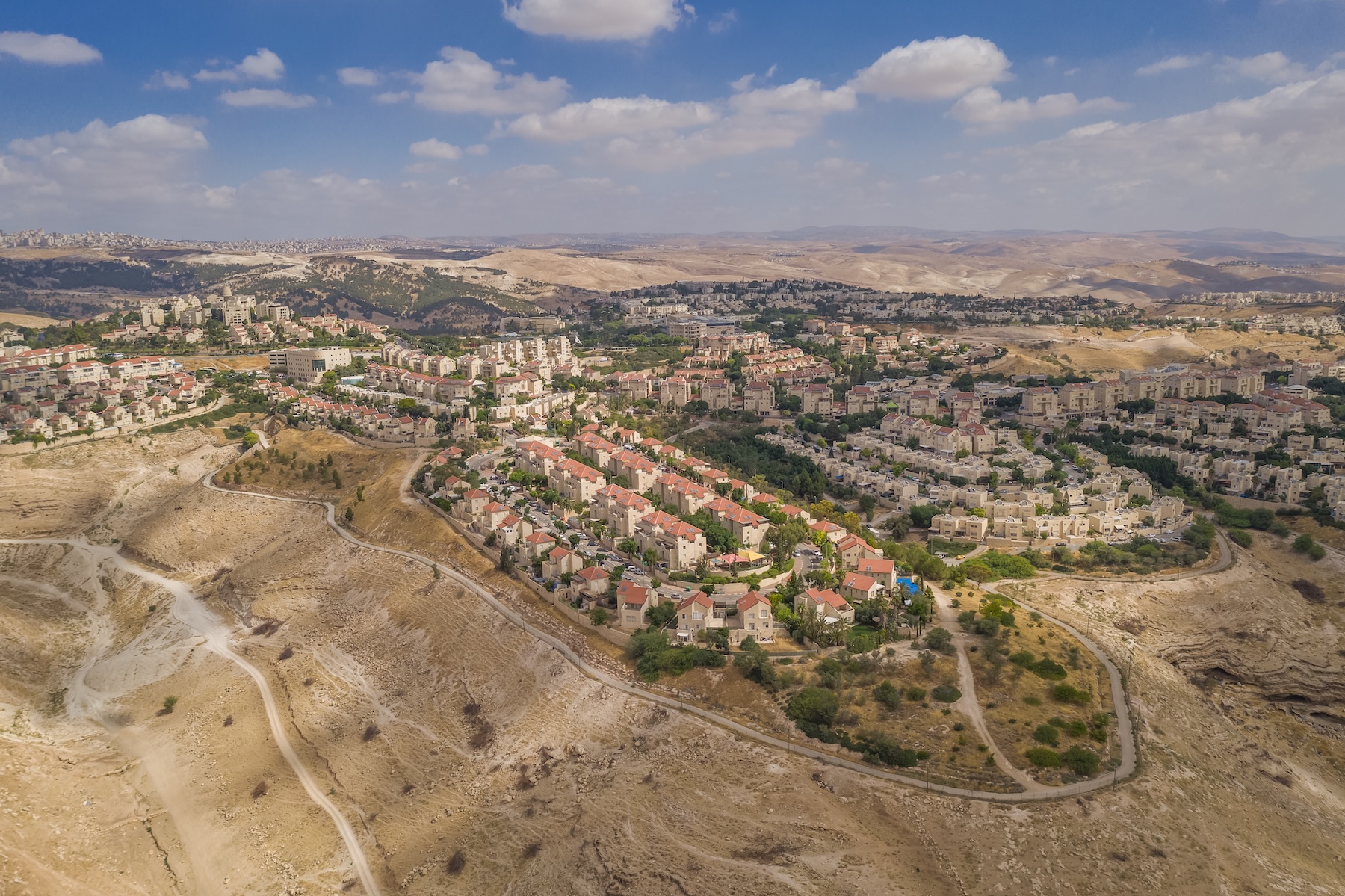
In the world today the word “settler” brings to mind the image of foreign colonisers, but in reality, Jews living in Judea and Samaria are returning to the cradle of their civilisation: Hebron, Shiloh, Beit El, and Shechem are biblical towns where Jewish life thrived for millennia. In the words of legal scholar Eugene Kontorovich: “Israel’s presence in the West Bank is not an occupation under international law, because there was no prior lawful sovereign, and the land was allocated to the Jewish people under binding international law”.
Background – Europe’s rejection of Jewish history and legal claims
Unfortunately, the European Union (and its predecessor the EEC) has chosen to ignore the history of the land prior to the June 1967 war. The EU has since 1970’s demanded that Israel end its occupation of what it regards as Palestinian territory. In 1980, the EEC issued the Venice Declaration, which essentially committed the Europeans to support the PLO in its efforts to enable the Palestinian people “to fully exercise their right to self-determination”.
6. A just solution must finally be found to the Palestinian problem, which is not simply one of refugees. The Palestinian people, which is conscious of existing as such, must be placed in a position, by an appropriate process defined within the framework of the comprehensive peace settlement, to exercise fully its right to self-determination.
9. The Nine stress the need for Israel to put an end to the territorial occupation which it has maintained since the conflict of 1967, as it has done for part of Sinai. They are deeply convinced that the Israeli settlements constitute a serious obstacle to the peace process in the Middle East. The Nine consider that these settlements, as well as modifications in population and property in the occupied Arab territories, are illegal under international law.
In article 7 the Europeans demanded that the PLO be associated with negotiations.
Since 1980, the European position has hardened into a demand that a Palestinian state be established in the entirety of the “occupied” territories.
The EU’s most recent actions targeting Israeli “settlers” has been stimulated by the 2024 Advisory Opinion of the International Court of Justice, in which a majority of the Court’s members opined that Israel’s occupation of the territories captured by Israel in June 1967 has become illegal, and that Israel must remove Israeli’s from these territories. Several of the Court’s own judges were highly critical of this conclusion.
This majority Opinion is often regarded as justifying the view that somehow all Israelis in these territories are illegal. However, such an approach is highly problematic from a historical perspective, as it completely disregards the facts (as inferred in the introduction to the article above) that Jews have been living in what is now known as the “West Bank” for millennia, that Jordan ethnically cleansed Jerusalem and the West Bank of Jews between 1948 and 1967, and that many Jews who now live there are neither responsible for the Israeli military administration nor have they ever been “deported” or “transferred” by the State of Israel within the meaning of article 49(6) of the Fourth genocide Convention (this provision being the sole ground for the claim that settlements are illegal), nor does their presence as such prevent Palestinians from fulfilling their self-determination rights. (Read our extensive report on the 2024 Advisory Opinion here. )
As for the lawful presence of Jewish people in the West Bank, its noteworthy to refer to the dissenting opinion by Judge Sebutinde in the 2024 Advisory Opinion of the International Court of Justice. She writes that, “whilst the exact nature of the rights conferred under the Mandate has been the subject of much discussion, the language of the Mandate shows that with respect to the territory then known as “Palestine”, the Jewish people were the main beneficiaries of those rights.”[1] According to Sebutinde, the Mandate clearly confirmed the right of the Jewish people to settle, self-determine and live peacefully in the Mandate territory. This Mandate territory includes the territory, known as the “West Bank”.
Restrictive measures
It is against the background of the European bias towards the Palestinians that we must view the most recent efforts of the European Union to make the presence of Jewish life in the West Bank a sanctionable offense.
On May 28th the European Council adopted additional restrictive measures against four entities and three individualsunder the European Union’s Global Human Rights Sanctions Regime. Those targeted by the measures are labelled by the Council as “extremist Israeli settlers and organizations”, which are “responsible for serious and systematic human rights abuses against Palestinians in the West Bank, including abuse of the right of everyone to enjoy the highest attainable standard of physical and mental integrity, the right to property, the right to private and family life, to freedom of religion or belief and the right to education.” As this article will further elaborate, the European Union, based on false accusations and questionable legal reasoning, turned the very idea of Jews living in the West Bank into a sanctionable offense and an inherent violation of Palestinian human rights.
The designations include the Nachala Settlement Movement and its Director Daniella Weiss. According to the European Council, the movement encourages and facilitates coercive acts that lead to the forced displacement of Palestinians. The Council also lists the Israeli NGO Regavim and its director Meir Deutsch. The council remarks that Regavim and its leadership lobby for the demolition of Palestinian property “with the aim to expand the control of Israel to the whole West Bank and institute legal proceedings to that end.”[2] Restrictive measures are also imposed against the Hashomer Yosh NGO – an organization that offers material support and coordinates volunteers on the herding farms, supporting outposts and settlements in the West Bank – and its president Avichai Suissa. Additionally, the Council lists the Amana cooperative association of the settler movement Gush Emunim. Since its creation, Amana has played a key role in initiating, financing, and facilitating at least 30 – in view of the Council: ‘violent’ – outposts and settlements.
The fabricated narrative of settler violence
In the first place, the European Union’s policy deliberately mixes together criminal acts by a small number of Israelis against Palestinians—acts that are both inseparable from and greatly outnumbered by acts of terrorism by Palestinians.[3] Israel’s leaders and rabbis condemn criminal acts by settlers unconditionally, in contrast with the Palestinian Authority, which pays pensions to its terrorists. The rate of incidents that are solved is low, but that is also true of property crime in U.S. and European cities.
In the second place it should be noted how the “settler violence” story is made up. The production cycle is as followed: A deceptive NGO report[4][5] becomes a settled account, heralded by human-rights organizations that are themselves funded by the European Union. Subsequently, reporters and international bodies cite these NGOs without independent verification, followed by policymakers who cite the resulting consensus. The European states that funded the NGOs making the claims then impose sanctions accordingly. What passes for evidence is often nothing more than a chain of ideological citations. And when a handful of these stories were finally forced to address facts, the narrative fell apart.[6]
Thirdly, one should look at the case of Amana. Following the Biden administration’s lead, the European Union sanctioned Amana for “initiating, financing, and facilitating at least 30 violent outposts and settlements.”[7] The word violent in that sentence is doing the work here. What makes an outpost “violent”? Amana pours concrete and lays roads. But under the definitions used by the United Nations, anything from exercising self-defense to an individual committing petty theft is classified as “violence”. This then allows the European Union to state with a straight face that Amana “facilitated violent outposts” without identifying a single act of violence that Amana directed, funded, or encouraged. Nowhere in its report does the Council name one single violent incident committed by Amana.[8] As one can see: this is not a legal standard but a word game.
Conclusion
There is no doubt that there have been isolated acts of violence by Israeli’s against Palestinians in the West Bank. These are illegal under Israeli law, and Israel should ensure they are prevented punished. However, framing settler violence as a crisis threatening global security reinforces a narrative of predatory fundamentalist Jews dispossessing Palestinians.
Criminal activity level of by Jews in Judea and Samaria is a domestic Israeli law enforcement matter and should be treated as such. As this article has shown, the ‘settler violence’ story is fabricated and often thrown into the world without any supporting evidence. The European Union should stop its policy that undermines Israel’s legitimate sovereign rights to security and territorial integrity, and even more keep itself from turning Jewish presence in the West Bank into a sanctionable offense.
[1] Dissenting opinion of Vice-President Sebutinde
[2] Extremist Israeli settlers: EU lists four entities and three individuals – Consilium Extremist Israeli settlers: EU lists four entities and three individuals – Consilium
[3] In 2023, there were over 3,000 Palestinian terror attacks in Judea and Samaria — including shootings, stabbings, IEDs, and rock/molotov attacks — compared to a few dozen isolated Jewish reprisals (Shin Bet Annual Report, 2023).
[4] An example of such a report is by Yesh Din that is often trumpeted by human rights organization. The name of that report is ‘Alleged Investigation: The Failure of Investigations Into Offenses Committed by IDF Soldiers Against Palestinians.’ According to this Israeli NGO report, only 3% of cases of settler violence in the West Bank leads to a full or partial conviction. However, these statistics are presented without reference to other legal systems (Israeli civilian or other militaries); it is impossible to determine if the situation in the West Bank is an aberration or reflective of a well-functioning mechanism. According to data from the Knesset’s Research and Evaluation Center, which were not included in the Yesh Din report, 9% of criminal investigations against Israeli police officers in 2009 resulted in indictment. In the same year, according to Yesh Din, the figure for the IDF in the West Bank was 7%. This highlights the importance of using comparative data, which Yesh Din did not do.
[5] According to NGO monitor, NGOs and UN agencies that claim to perform fact-finding within the context of the Arab-Israeli conflict operate similarly, basing their publications on hearsay and second-hand accounts, without verifying the allegations. B’Tselem’s False Information and Flawed Methodology: Court Ruling Spotlights NGO “Investigations” – ngomonitor
[6] See note 4 and 5.
[7] Extremist Israeli settlers: EU lists four entities and three individuals – Consilium
[8] Extremist Israeli settlers: EU lists four entities and three individuals – Consilium