By Andrew Tucker, Director General thinc.
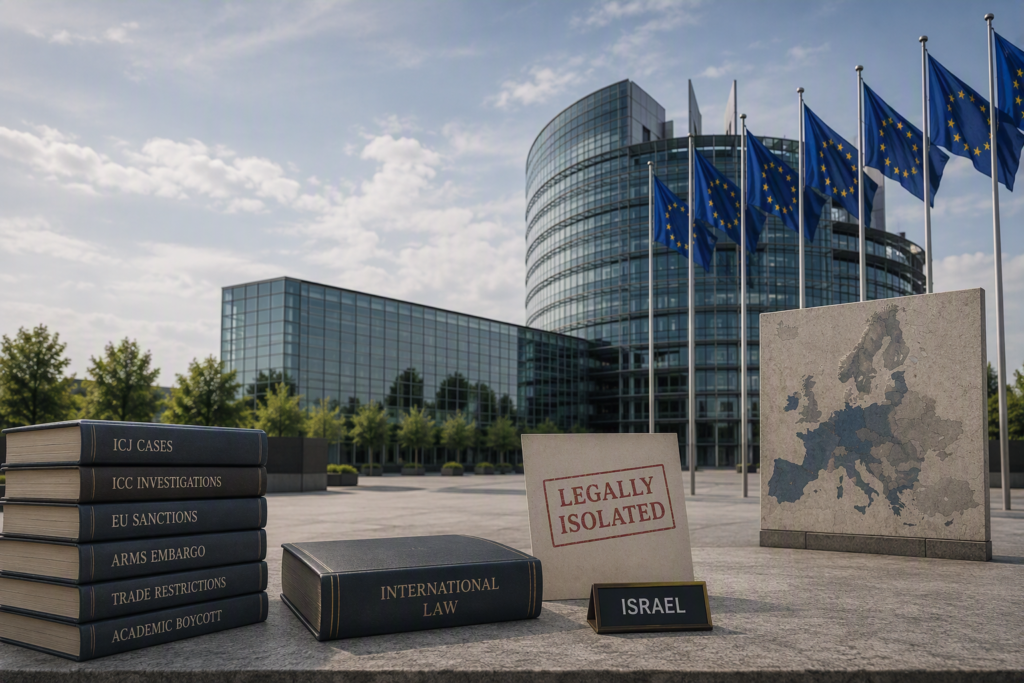
What appears to be a legal conflict is raging over Israel’s presence and activities in Gaza, “East Jerusalem” and “the West Bank”. Legal terms such as “genocide”, “occupation” and “illegal settlements” are repeated ad nauseum in the media. And the international legal system is increasingly being used to put pressure on Israel to remove all of its citizens from what are claimed to be Palestinian territories, and to give the Palestinians the state to which they are (it is alleged) entitled.
In the International Court of Justice (ICJ), Nicaragua is suing Germany for the latter’s provision of support to the Israel during its military campaign in the Gaza Strip. Nicaragua argues that Germany is aiding and abetting Israel’s genocide of the Palestinians. In the same court, the claim of genocide brought by South Africa against Israel remains pending, the court having recently extended the written proceedings by another three years (36 months).
In parallel, a number of European states are pushing very hard to punish Israel for creating obstacles to the establishment of a Palestinian state. Most recently, the Dutch government introduced sanctions on trade in products emanating from territory occupied by Israel (last week legal proceedings were taken to oppose these measures). The UK plans to do the same. The EU recently imposed sanctions on violent Israeli settlers. There is a strong move in Brussels to cancel the EU-Israel Association Agreement. European universities such as Leiden are severing all ties with Israeli academic institutions.
Hostility towards Israel’s presence in Jerusalem, Judea and Samaria (and Gaza) runs very deep in European/Western legal and political elite. But their legal claims are not based on legal analysis. Rather, a closer examination reveals that the legal analysis has been concocted over the decades to support European, Arab and certain Israeli/Jewish ideological and political interests. That is a fascinating story that has been, so far, largely ignored.
Indeed, this apparently legal battle provides a fascinating study in the use and manipulation of international law – principles and institutions – to buttress positions that are, in fact, driven by ideological, religious, political and economic interests.
Quite simply, the “two states” legal/political mantra – ie. the position that is repeated ad nauseum that international law demands the establishment of a Palestinian state adjacent to Israel, comprising the totality of the territories captured by Israel in June 1967, including East Jerusalem as its capital – has no firm foundation in legal reasoning. Rather, it is the product of an alliance since the 1970s between (i) European self-interest, (ii) Arab/Islamic antisemitism and (iii) a certain stream of Jewish anti-Zionism.
In our book “Two States for Two Peoples?” (2023), Professors Bock, Rose and I unpacked this phenomenon. The book contains a detailed study of the period 1967-1980, in which upcoming Jewish jurists such as Joseph Weiler, Yoram Dinstein and Theodor Meron laid the legal foundations for the “Two states” legal narrative which claims that Israel is a “mere occupying power” that does not AND CANNOT have any territorial claims to the territories captured from Jordan and Egypt in the June 1967 Six Day War.
In the decade following the Yom Kippur War (1973), the European states that formed the EEC (especially Germany and France, supported by Netherlands) entered into their partnership with the Arab world: the Euro-Arab Dialogue (EAD) (which historian Bat Ye’or calls “Eurabia”), reflected in the 1980 Venice Declaration, that laid the foundation of the EU’s anti-Israel stance we see today (BDS etc).
Since 1980, the European academic elite has embraced this anti-Zionist framing of the Israeli-Palestinian conflict, which has become mainstream across the globe.
Thus British/French Professor Philippe Sands could unashamedly put a narrative, on behalf of the Palestinians in the ICJ, and supported by many European and Arab states, that denies the Jewish people any rights of national existence in Palestine. This framing was adopted wholesale by a majority of the Court’s judges, resulting in the 2024 ICJ Advisory Opinion. And yet, that claim has no basis in law; there is no compelling case for arguing that Palestinian self-determination claims are absolute, or that the mere fact of Israel’s military occupation means it has no legitimate territorial claims.
Several states intervened in those Advisory Opinion proceedings in support of Israel (which itself did not participate in a substantive way). Fiji was the only state in those proceedings to challenge the “two states” narrative in a substantive way, arguing that the Mandate for Palestine (1922) formed the legal foundation upon which legal status of Jerusalem, Judea and Samaria must be analysed. This intervention possibly triggered Judge Julia Sebutinde to write her separate opinion in which she powerfully debunks the “two states” historical/legal narrative.
It is through this anti-Zionist lens that most of the political and legal elite in the West look at Israel’s presence in East Jerusalem, the West Bank and Gaza. The presumption is that Israel has no right to be in these territories, and must have sinister motives for continuing to oppress the Palestinians.