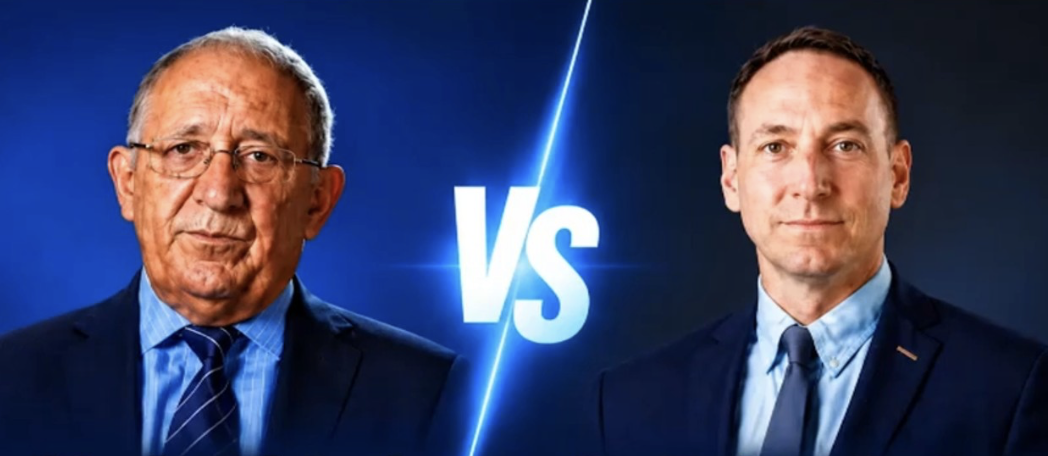
Hague-based international lawyer Prof. Dr. Geert-Jan Alexander Knoops argues that the UN Commission of Inquiry’s genocide finding rests on a standard of proof and a source base that fall short of what the International Court of Justice requires.
When the UN Human Rights Council’s Commission of Inquiry on the Occupied Palestinian Territory and Israel, chaired by Navi Pillay, concluded in September 2025 that Israel had committed genocide in Gaza, the finding quickly entered public debate as settled fact.
Professor Knoops, defense counsel before international tribunals in The Hague and Professor of Politics of International Law at the University of Amsterdam, says that is a mistake.
In a recent article with researcher Anna Michel Albo, Knoops traced the report’s footnotes. “The main conclusion of our research was not to admonish the drafters of the Pillay report,” he says, “but simply to show the international community that we should be very cautious with these types of reports when it concerns the crime of crimes, namely genocide.”
A low bar for the gravest charge
Such reports, “although they can be at face value important to start investigation, can never substitute a rigorous evidentiary standard when we have to determine if a person or a country is guilty of the crime of genocide,” Knoops says.
The core problem is the standard of proof. The Commission asked whether there were reasonable grounds to conclude that Israel had breached the Genocide Convention. The ICJ, since Bosnia v. Serbia (2007), requires fully conclusive evidence. “This report does not meet the standard,” Knoops says. It “has used a very low standard to conclude that genocide has occurred.”
A closed circle of sources
The issue, he stresses, is not whether a court may admit the report, but how much weight it deserves. By the authors’ count, about 49% of its sources are UN material: 30% official UN documents and 19% UN agency reports. Only 6% are academic or peer-reviewed research, the external, independent sources Knoops considers essential for so grave a conclusion. Another 5% could not be traced at all.
When an institution leans this heavily on its own earlier output, he argues, it risks circular reasoning: prior positions are recycled as evidence instead of being tested against independent material.
Access, intent and proof
The Commission and its defenders point out that Israel denied investigators access to Gaza, leaving secondary sources as the only option. Knoops accepts that a commission may then rely on such material, but says this should lower the weight of its findings. Whether non-cooperation should count against a state depends on its reasons, including doubts about a commission’s independence. The ICJ faces a similar question in The Gambia v. Myanmar.
On intent, the heart of any genocide case, the ICJ allows inference from a pattern of conduct only where genocidal intent is the only reasonable inference. Heavy loss of life in urban warfare does not, in Knoops’s view, by itself prove a state policy to destroy a group. That policy must be shown through concrete evidence, not reports built on reasonable grounds.
What readers should ask
His advice to journalists, students and the public: weigh information from both sides and ask what each claim rests on. Overuse, he warns, deflates the word genocide, and its sources deserve scrutiny before a state or people is stigmatised with it.