As the International Court of Justice prepares its judgment in The Gambia v. Myanmar, two US legal experts warn that a “holistic” test for genocidal intent would blur the line between war and genocide.
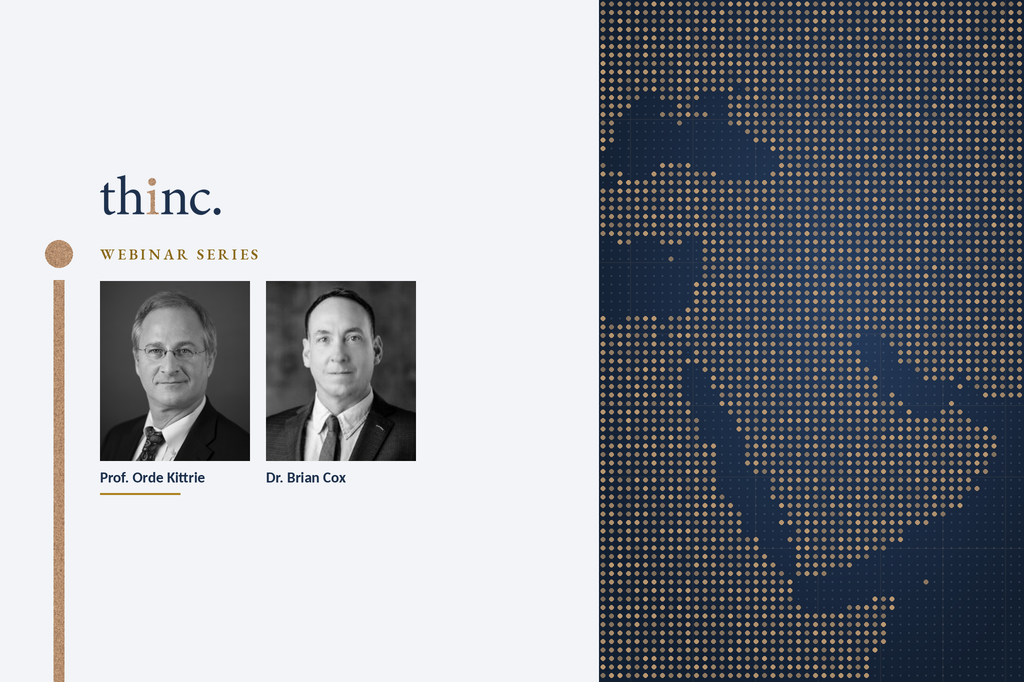
Speakers: Prof. Orde Kittrie (Arizona State University; Foundation for Defense of Democracies; former US State Department lawyer) · Dr. Brian Cox (Macdonald-Laurier Institute; former Cornell Law School faculty; former US Army legal adviser) · Host: Andrew Tucker, thinc.
Key Webinar Highlights:
- Adopting the holistic approach to proving genocidal intent would exceed the ICJ’s judicial role.Prof. Orde Kittrie: “It would transform the Court into a legislative body rewriting the treaty.”
- Because the holistic interpretation focuses on effects, it plays into the hands of terrorist groups like Hamas which deliberately use human shields to maximize civilian casualties. Prof. Orde Kittrie: “The result of this approach will be that the more a terrorist group hides among civilians, the stronger the genocide case against its opponent.”
- The International Court of Justice should not rely on the reports of UN bodies. Dr. Brian Cox: “UN Human Rights bodies like the Commission of Inquiry on Israel and Palestine work to a “reasonable grounds to believe” standard of proof, often lack military expertise, and are not necessarily neutral.”
Genocide is defined by intent: acts committed “with intent to destroy, in whole or in part” a national, ethnical, racial or religious group “as such.” That is what sets it apart from every other international crime. Even very large numbers of deaths, host Dr. Andrew Tucker reminded the audience, are not proof of genocide without proof of intent.
Until now, only one ICJ case has ended in a finding that genocide occurred: Bosnia and Herzegovina v. Serbia and Montenegro (2007). Today five Genocide Convention cases are pending, among them The Gambia v. Myanmar, South Africa v. Israel and Nicaragua v. Germany. When intent is inferred from a pattern of conduct, the Court has required that it be the only reasonable inference (Bosnia v. Serbia, 2007; Croatia v. Serbia, 2015). In November 2023, Canada, Denmark, France, Germany, the Netherlands and the United Kingdom intervened in The Gambia v. Myanmar. They asked the Court to assess intent more “holistically”, arguing that the current test sets the bar unduly high. The judgment is scheduled for 19 November 2026.
Interpretation or rewriting?
For Prof. Kittrie, adopting that approach would “exceed the ICJ’s judicial role”: “It transforms it into a legislative body rewriting the treaty.” He also argues it is unnecessary in this case. In his view, Myanmar’s mass executions of Rohingya civilians already meet the existing standard. He recalled a 1978 warning by former ICJ President Nagendra Singh:
“A tribunal indulging in unnecessary pronouncements by making them when not legally required to do so, could easily undermine its judicial character.”
ICJ decisions bind only the parties, Kittrie noted, but the Court rarely departs from its own case law, and the UN and national courts treat its rulings as authoritative. A lower threshold could therefore spread to the International Criminal Court and to national courts exercising universal jurisdiction.
“Genocide or nothing”
Why the pressure to widen genocide? Kittrie points to jurisdiction. The Genocide Convention gives the ICJ jurisdiction over disputes between states, but the Geneva Conventions and other law-of-war treaties do not. As one leading ICJ litigator put it, applicants must “shoehorn” their claims into genocide, because “it’s genocide or it’s nothing.”
Provisional measures add a further incentive. A state can obtain orders restricting another state’s military campaign before the merits are decided. As former ICJ President Joan Donoghue later clarified, the Court’s 2024 order in South Africa v. Israel found that Palestinians had a plausible right to
protection from genocide, not that South Africa’s genocide claim was plausible. Yet the orders bind only Israel: the Court has no authority over Hamas.
Why the bar must stay high
Dr. Cox explained that states rarely declare an intent to destroy a group. A court must therefore construct that intent from the evidence. If the Court is “essentially substituting its own interpretation of the intent” for the state’s, he said, “it absolutely does need to have an incredibly high bar.”
That task is harder still because, in Cox’s assessment, few ICJ judges have practical experience of the law of armed conflict. They depend on the parties’ submissions, which may misstate how those rules are applied in practice.
From process to effects
Cox, a former US Army legal adviser, stressed that the law of armed conflict “is not an effects-based construct.” Distinction and proportionality turn on what a commander knew and intended when the attack was decided, not on casualty totals afterwards. A holistic approach that infers intent from displacement or casualty figures turns these process-based rules into effects-based ones.
The point is not that lawful conduct rules genocide out. Cox recalled that a state can fight a conventional military campaign while separately pursuing extermination, as Nazi Germany did with the Holocaust. But conduct that complies with the law of armed conflict is not itself evidence of genocidal intent.
The concern is old. An audience member noted that the Convention’s drafters warned against mixing war and genocide by treating civilian casualties as proof. Cox agreed, warning that under a holistic test casualty figures would not be presented as the sole evidence, but as “a factor among many.” Kittrie warned of the consequences for urban warfare against groups that embed themselves among civilians:
“The more a terrorist group hides among civilians, the stronger the genocide case against its opponent.” Prof. Orde Kittrie
Coalition campaigns against ISIS in Mosul and Raqqa could be recast as genocidal under such a test, he argued. States might also hesitate to contribute peacekeepers. “Every civilian casualty is a tragedy,” Kittrie said, “but because there was a civilian casualty does not mean that genocide was committed.”
The information battlefield
Why do such accusations matter if they are “just words”? Kittrie argued that armed groups now wage kinetic war partly to fuel information warfare. In his assessment, “Hamas has lost the war against Israel from a kinetic perspective, but they’ve won the war against Israel from an information warfare perspective.” A lower threshold, he warned, would hand future terrorist groups and dictatorships the same tool against Western militaries and peacekeepers.
UN reports as evidence
The six intervening states argued that UN fact-finding missions and commissions of inquiry deserve “particular probative value” as a “disinterested witness.” Cox disputed this. Such bodies work to a “reasonable grounds to believe” standard of proof, often lack military expertise, and are not necessarily neutral.
He also criticised the selective use of Israeli political statements. Prime Minister Netanyahu’s reference to “remember what Amalek did to you” is cited as evidence of intent to destroy Palestinians. The same statements set out the campaign’s aims: returning the hostages and ending the threat posed by Hamas. Where two inferences are reasonable, Cox explained, the “only reasonable inference” test is not met. A holistic test would let the court pick between them.
What comes next
A ruling against Israel in South Africa v. Israel would carry consequences well beyond the Court, Cox warned. States that support Israel could withhold that support under their duty to prevent genocide. Individual service members could face prosecution abroad. Kittrie pointed to Nicaragua v. Germany, where a lower threshold could expose states that provide military aid to complicity claims. Cox suggested that states concerned for their own operations consider their position on Article IX, the Convention’s ICJ jurisdiction clause.
Part of the thinc. webinar series on international law and the Middle East. The views expressed are those of the speakers.